 Image 1 of 2
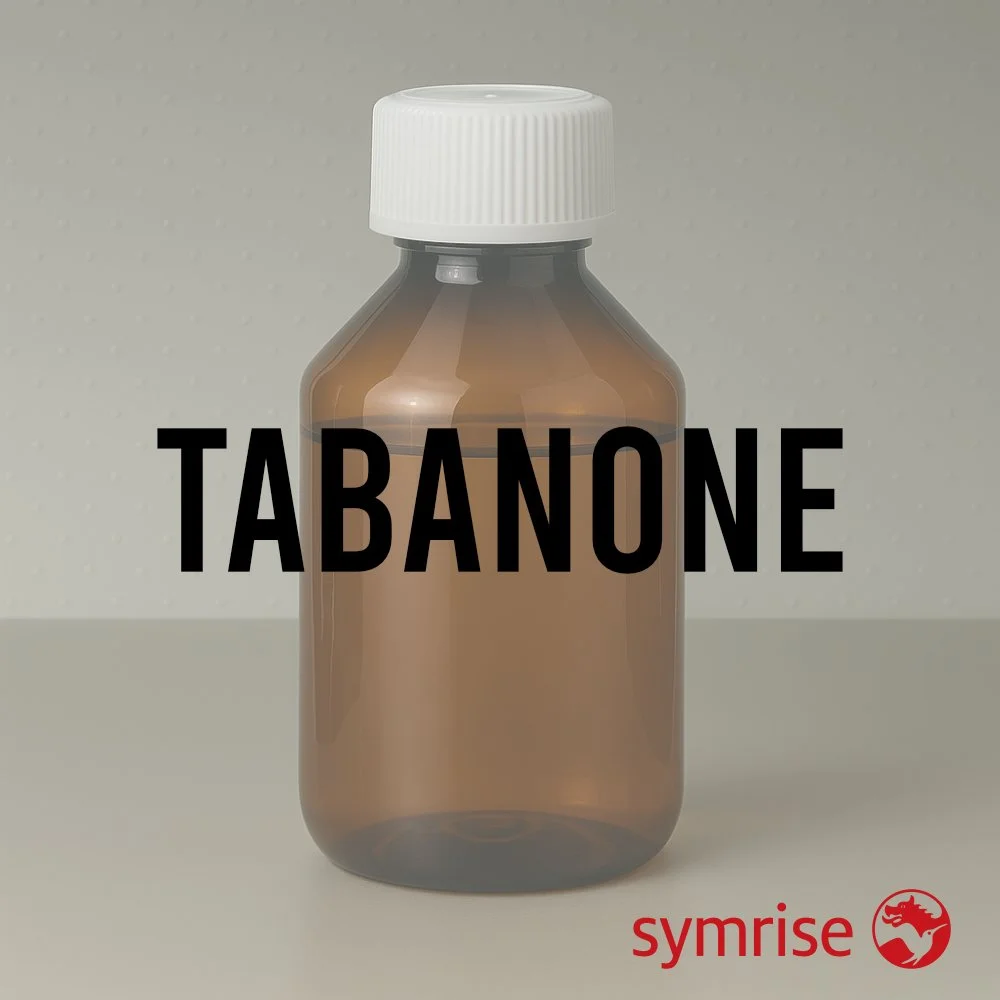 Image 2 of 2
Tabanone (Megastigmatrienone) - Technical Ingredient Overview
🏭 Manufacturer — Symrise (primary developer and supplier)
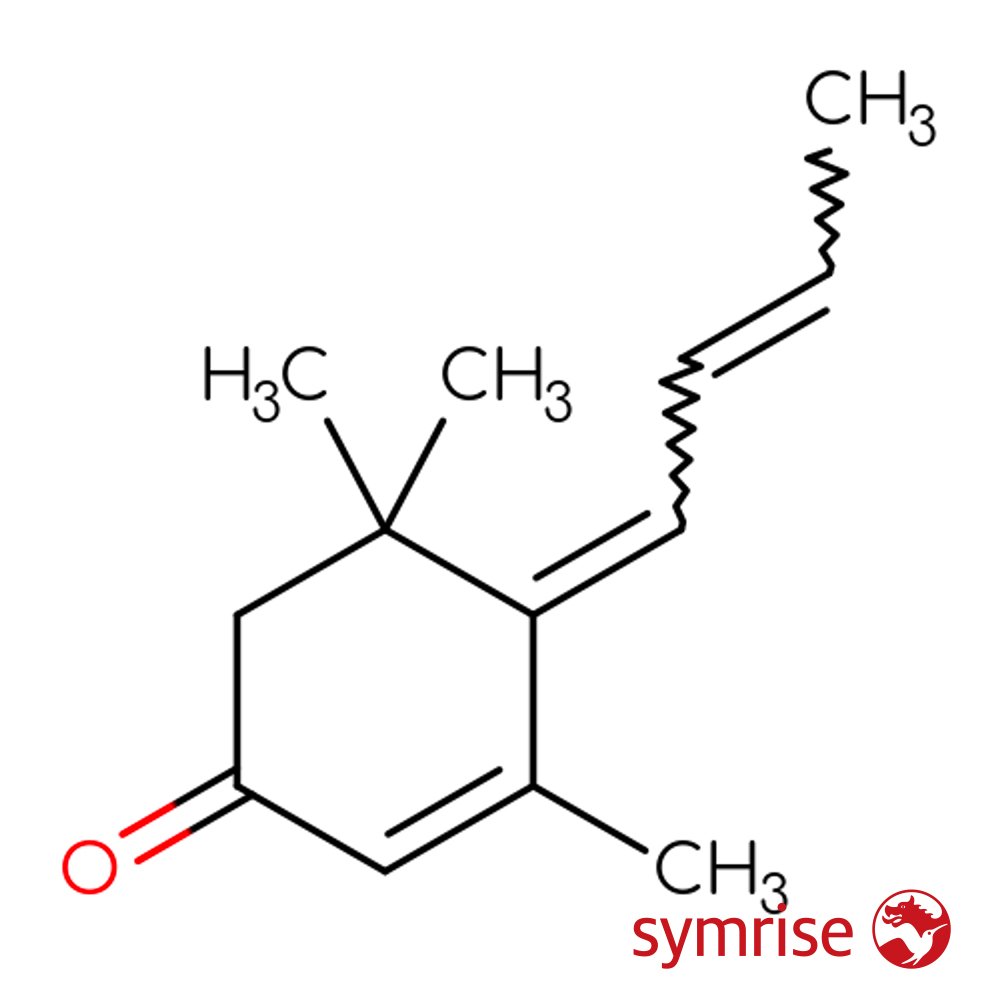
🔎 Chemical Name — 4-(2-Butenylidene)-3,5,5-trimethylcyclohex-2-en-1-one; 2-Cyclohexen-1-one, 4-(2-buten-1-ylidene)-3,5,5-trimethyl-
🧪 Synonyms — Megastigmatrienone, 4,6,8-Megastigmatrien-3-one, (E,E/E,Z)-tobacco cyclohexenone, Butenylidene trimethyl cyclohexenone
📂 CAS Number — 13215-88-8
📘 FEMA Number — 4663 (GRAS approved for controlled flavor use)
⚖️ Molecular Weight — 190.28 g/mol (C₁₃H₁₈O)
📝 Odor Type — Tobacco-Balsamic
📈 Odor Strength — High to Very High (extremely powerful and diffusive)
👃🏼 Odor Profile — Warm, dry-sweet tobacco with fruity-plum, acorn, and balsamic nuances. Indescribably radiant, powerful, and brilliant tobacco character with soft leather and spicy undertones
⚗️ Uses — Tobacco accords, heart note booster, mid-base connector, oriental and woody-ambery fragrances
🧴 Appearance — Slightly yellow to yellow liquid
What is Tabanone?
Tabanone is a synthetic cyclohexenone derivative developed and manufactured by Symrise, representing one of the most significant modern tobacco-type fragrance molecules in contemporary perfumery. Chemically classified as megastigmatrienone, this material exists as a mixture of geometric isomers (E,E and E,Z configurations), which contributes to its complex and radiant olfactory profile.
Structurally, Tabanone belongs to the carotenoid-derived aromatic compound family, featuring an unsaturated cyclohexenone ring system with extended conjugation that produces its characteristic warm, fruity-tobacco character. This molecular architecture allows the material to function effectively across both the heart and base note zones, providing exceptional diffusion properties while maintaining substantive longevity.
Unlike traditional tobacco aromatics such as isobutyl quinoline or phenolic tar derivatives—which often present harsh, acrid, or overtly smoky characteristics—Tabanone delivers a smooth, clean, and decidedly modern interpretation of tobacco. The material evokes what perfumers describe as "blond tobacco": the warm, slightly sweet, honey-like character of cured Virginia tobacco leaves with pronounced balsamic warmth, subtle fruit-leather accents, and a persistent aromatic trail devoid of ash-like or burnt notes.
Tabanone occurs naturally as a key volatile flavor compound in cured tobacco leaves (Nicotiana tabacum), where it contributes significantly to tobacco aroma. It has also been identified in passion fruit, Virginia tobacco, aged wines, and as a metabolite of brewer's yeast. However, all commercial Tabanone for fragrance and flavor applications is produced synthetically, typically through the dehydration of 3-oxo-α-ionol, ensuring consistent quality and eliminating dependence on natural extraction.
Historical Background
The development of Tabanone represents a landmark achievement in synthetic tobacco chemistry, emerging during the latter decades of the 20th century as part of Symrise's (and its predecessor companies') systematic research into carotenoid-derived fragrance molecules. This research program also yielded other significant perfumery materials including the damascones, ionones, and related norisoprenoids—all sharing structural relationships through carotenoid degradation pathways.
Tabanone's introduction to perfumery occurred during an era when synthetic chemistry was revolutionizing tobacco accords. Traditional tobacco perfumery had relied heavily on natural tobacco leaf absolutes, which—while authentic—presented challenges including color (dark brown, prohibitive for many applications), high cost, supply variability, and complex regulatory considerations. The industry sought cleaner, more versatile tobacco-building blocks that could deliver authentic character without these limitations.
The identification of megastigmatrienone as a principal odorant in Virginia tobacco and subsequent development of efficient synthetic routes positioned Tabanone as a breakthrough material. Renowned perfumer and fragrance chemistry expert Arcadi Boix Camps, writing in 1985, praised Tabanone with extraordinary enthusiasm, describing it as "a product of supreme importance both in the perfumery of the future and the chemical composition of today's tobacco." He characterized it as having "indescribable tobacco scents, is fruity, radiant, powerful and brilliant," declaring: "Its use may lead us to a new era in perfumery. I have no hesitation in placing this aromatic chemical among the elite of the chemical products that include Hedione, the irones, the Damascones, and theaspirane."
This assessment proved prescient. Throughout the late 20th and early 21st centuries, Tabanone established itself as an indispensable component in modern tobacco fragrance construction, appearing in both mainstream and niche perfumery. Symrise has continued to refine and promote the material, including developing proprietary grades such as "Tabanone Coeur" (heart) for use in their prestigious de Laire perfume bases, notably in "Tabac Bourbon DL," which showcases Tabanone alongside Tonkalactone, Bourbon vanilla absolute, and Madagascar cinnamon to create sophisticated, addictive tobacco accords without actual tobacco extracts.
📖 Explore the Story: For a deeper dive into Arcadi Boix Camps' prophetic 1985 proclamation, the revival of the legendary de Laire bases, and how Tabanone transformed modern tobacco perfumery, read our comprehensive blog post: Tabanone: The Secret That Makes Tobacco Notes Irresistible
Olfactory Profile
Scent Family
Tobacco-Balsamic with Fruity-Woody Undertones
Tabanone occupies a distinctive position at the intersection of tobacco, balsamic, and fruity-woody fragrance families, offering what perfumers recognize as quintessential "blond tobacco" character—warm, slightly sweet, honey-balsamic, and decidedly elegant.
Main Descriptors
Primary: Warm dry tobacco, sweet acorn, fruity-plum
Secondary: Balsamic, honey-like, soft leather
Tertiary: Spicy, nutty, subtle apricot, cedary-woody nuances
Character: Radiant, powerful, diffusive, brilliant, indescribably complex
The scent opens with warm, dry tobacco notes reminiscent of cured Virginia leaf, but without harsh, acrid, or overtly smoky aspects. This is immediately accompanied by distinctive fruity-plum and sweet acorn characteristics that lend natural richness and depth. The plum facet suggests stone fruit warmth—almost apricot-like in quality—while the acorn note provides nutty, slightly bitter-sweet complexity.
Throughout development, balsamic warmth becomes increasingly prominent, contributing honey-like sweetness and soft leather undertones. These leather facets are refined and suede-like rather than raw or animalic. Subtle spicy nuances—cedary-woody, slightly metallic, with faint caramel depth—emerge in the background, adding structural complexity without dominating the overall tobacco signature.
The material's radiance and diffusion are extraordinary. Even at trace concentrations, Tabanone projects powerfully, creating what perfumers describe as an "aura" around the fragrance. This diffusive quality, combined with its ability to blend seamlessly with other materials, makes it invaluable for creating modern, wearable tobacco fragrances that avoid heaviness or dated associations.
Intensity
Very high to extremely high odor strength. Tabanone ranks among the most powerful tobacco-type materials in perfumery, requiring careful dosing—typically used in traces (often 0.1-1% in final compositions) to achieve desired effects. Its impact-to-cost ratio is exceptional, making it economically attractive despite its potency necessitating minimal usage levels.
Tenacity
Good to excellent persistence. While operating primarily in the heart note zone, Tabanone extends substantially into the base, providing lasting tobacco character that can remain detectable on blotters for days and on skin for many hours. This intermediate-to-long longevity makes it particularly valuable as a "heart note booster" and mid-base connector, bridging volatile top notes with heavier fixatives.
Volatility
Middle to base note
Tabanone's polarity and molecular structure position it firmly in the heart-to-base note range, with optimal impact occurring in the mid-development phases of fragrance evolution. This volatility profile allows it to function as both a substantive heart note material and a supporting base element, depending on concentration and surrounding composition.
Fixative Role
Functions as a moderate fixative with excellent tenacity-enhancing properties. While not a traditional heavy fixative like musks or resins, Tabanone contributes significantly to fragrance persistence, particularly in tobacco, oriental, and woody-balsamic constructions. Its ability to extend the life of mid-range notes while maintaining olfactive clarity makes it valuable in modern transparent woody-ambery structures where excessive fixation would be counterproductive.
Applications in Fine Fragrance
Tabanone's primary application lies in tobacco fragrance construction, where it functions as a cornerstone building block for modern tobacco accords. Unlike traditional approaches relying solely on tobacco leaf absolutes, contemporary perfumers use Tabanone to create cleaner, more versatile tobacco effects—often in combination with vanilla, tonka, hay notes, immortelle, and coumarin derivatives to build complete tobacco signatures.
In oriental fragrances, Tabanone contributes warm, balsamic depth with exotic spicy-sweet undertones, pairing effectively with amber bases, benzoin, labdanum, vanilla, and spice notes (cinnamon, clove, cardamom). The material's fruity-plum facets enhance gourmand orientals, while its leather aspects support darker, more mysterious amber-woody constructions.
Woody-ambery fragrances benefit from Tabanone's cedary-woody undertones and balsamic warmth. The material blends seamlessly with Iso E Super, Ambroxan, cedarwood derivatives, vetiver, patchouli, and sandalwood notes, adding complexity and radiance to transparent woody structures. Its ability to "lift" heavier woody bases while maintaining depth makes it particularly valuable in modern minimalist woody-ambery compositions.
The material also finds application in floral fragrances where tobacco-floral contrasts create sophisticated complexity. Tabanone pairs surprisingly well with osmanthus (sharing fruity-apricot facets), rose, jasmine, violet, and iris, creating unexpected juxtapositions that have become signatures of contemporary niche perfumery.
In masculine and unisex fragrances, Tabanone contributes essential "warmth" and "presence" without excessive sweetness or heaviness, making it ideal for modern aromatic-fougère structures, leather fragrances, and spicy-woody compositions targeting contemporary tastes.
Performance in Formula
Tabanone demonstrates exceptional blending behavior, functioning as what perfumers call a "team player" material. Its complex character allows it to enhance and support numerous other fragrance ingredients without dominating or conflicting. Particular affinities include:
With tobacco materials: Blends seamlessly with tobacco leaf absolute, immortelle, hay absolute, fenugreek, and other tobacco-type synthetics (tetrascone, megastigmadienone)
With balsamic notes: Enhances benzoin, vanilla, tonka bean, styrax, Peru balsam, and labdanum
With woody notes: Supports cedarwood, sandalwood, vetiver, patchouli, guaiacwood, and various woody-ambery synthetics
With spices: Complements cinnamon, clove, cardamom, nutmeg, and pepper notes
With florals: Creates sophisticated contrasts with rose, jasmine, osmanthus, violet, iris, and damascones
The material shows good stability in alcoholic solutions and across various pH ranges, though—as with all cyclohexenone derivatives—it can be sensitive to strong oxidizing conditions. Standard fragrance formulation practices ensure stability in finished compositions.
In functional perfumery applications, Tabanone's high impact and moderate volatility make it suitable for masculine grooming products, though its intensity requires careful dosing to avoid overwhelming other fragrance components.
Industrial & Technical Uses
Beyond fine fragrance, Tabanone serves important roles in flavor applications, where it holds FEMA GRAS status (4663) for controlled use in tobacco flavor mimicry. The material contributes authentic tobacco character to e-liquid flavors, tobacco flavoring systems, and certain food applications (typically in combination with other tobacco-type flavor components).
In functional fragrance, Tabanone appears in masculine bath products, shaving preparations, aftershaves, and body washes where its warm, balsamic tobacco-woody character adds sophistication and perceived "quality" to fragrance signatures. Its substantivity and persistence make it effective in rinse-off applications where longevity is valued.
The material also finds use in home fragrance applications including candles, reed diffusers, and room sprays, where its powerful diffusion creates ambient tobacco-woody atmospheres popular in luxury home scent markets.
From a research perspective, Tabanone's presence in tobacco and wine as a carotenoid-derived aromatic compound continues to attract scientific interest, with studies examining its formation pathways, sensory contributions, and potential applications in flavor science and oenology.
Regulatory & Safety Overview
IFRA Status
Permitted — No restrictions under IFRA Standards Amendment 51 (notified June 30, 2023). Tabanone (CAS 13215-88-8) may be used according to Good Manufacturing Practices across all 12 product categories without specific concentration limits. This ingredient does not appear on the IFRA prohibited or restricted lists. IFRA Standards Library
EU Cosmetics Regulation
Tabanone is not listed among the 26 mandatory declarable allergens under EU Cosmetics Regulation (EC) No 1223/2009. The material is permitted for use in cosmetic applications throughout the European Union under standard cosmetic ingredient regulations.
FEMA Status
FEMA 4663 — Approved as Generally Recognized As Safe (GRAS) for controlled flavor use, particularly in tobacco flavor systems. Usage is permitted under specific concentration limits as established by FEMA guidelines for flavor applications. FEMA GRAS Database
Toxicology
Tabanone's safety profile has been evaluated by the Research Institute for Fragrance Materials (RIFM), with a comprehensive fragrance ingredient safety assessment published for CAS 13215-88-8. The material demonstrates acceptable safety characteristics for intended fragrance and flavor applications when used at appropriate concentrations.
As with all high-impact fragrance materials, standard safety precautions apply during handling and formulation, including proper ventilation, use of personal protective equipment, and adherence to occupational exposure guidelines. The material's high potency means that formulators typically work with very small quantities, reducing overall exposure risks.
Safety data sheets note that Tabanone should be handled with care to avoid skin contact in undiluted form, as it may cause irritation. The material is combustible and should be stored away from oxidizing agents and ignition sources. Standard fragrance industry handling protocols are sufficient for safe use.
References
Boix Camps, A. (1985). Perfumery: Techniques in evolution. Perfumer & Flavorist, 29(5), 54-70.
Biosynth. (2024). Tabanone [Product information]. CAS 13215-88-8. https://www.biosynth.com/p/FT167655/13215-88-8-tabanone
Flavor and Extract Manufacturers Association. (2024). FEMA GRAS Database (No. 4663). https://www.femaflavor.org/
International Fragrance Association. (2023). IFRA Standards – 51st Amendment. https://ifrafragrance.org/safe-use/library
Slaghenaufi, D., Perello, M.-C., Marchand, S., & de Revel, G. (2016). Quantification of megastigmatrienone, a potential contributor to tobacco aroma in spirits. Food Chemistry, 203, 41–48. https://doi.org/10.1016/j.foodchem.2016.02.034
Symrise. (2024). Tabanon [Product information]. Ingredient Finder. https://www.symrise.com/
Wikipedia contributors. (2024). Nicotiana tabacum. In Wikipedia, The Free Encyclopedia. https://www.scientificlib.com/en/Biology/Plants/Magnoliophyta/NicotianaTabacum01.html
This technical overview has been curated by Scentspiracy for educational and professional reference purposes. All information is based on authoritative sources and industry documentation. For specific regulatory compliance in your jurisdiction, please consult local authorities and updated regulatory databases.