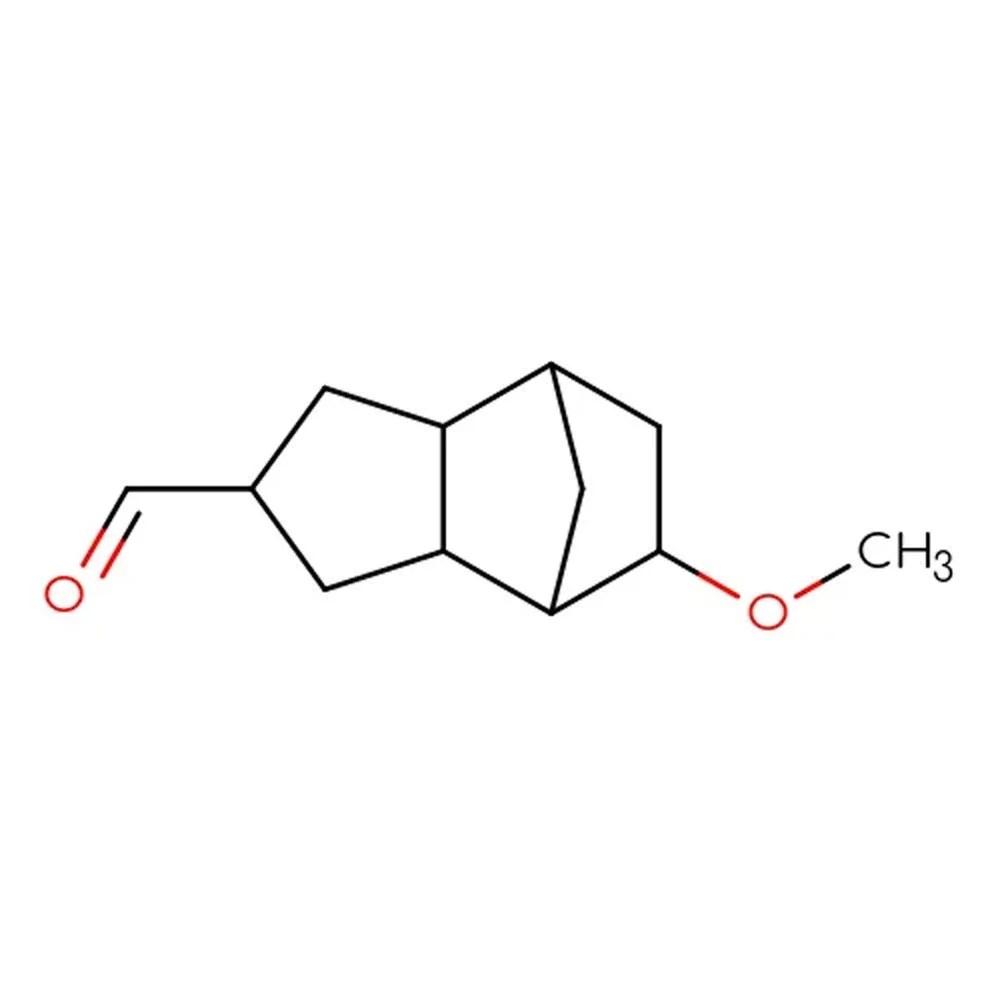
 Image 1 of 2
 Image 2 of 2
Scentenal™ (86803-90-9) Technical Ingredient Overview
🏭 Manufacturer — Firmenich
🔎 Chemical Name — 4,7-Methano-1H-indene-2-carboxaldehyde, octahydro-5-methoxy- (IUPAC)
🧪 Synonyms — Scentenal™; Octahydro-5-methoxyindanecarboxaldehyde; 4,7-Methano-1H-indene-2-carboxaldehyde, octahydro-5-methoxy-; 6-Methoxy dicyclopentadiene carboxaldehyde; Ocean carboxaldehyde; 8-methoxytricyclo[5.2.1.02,6]decane-4-carbaldehyde
📂 CAS Number — 86803-90-9
📘 FEMA Number — Not listed
⚖️ Molecular Weight — 194.27 g/mol
📝 Odor Type — Green-aldehydic, watery-floral, marine; ozonic aldehyde and functional green aldehyde
📈 Odor Strength — Strong diffuser; high odor intensity
👃🏼 Odor Profile — Metallic-ozonic sparkle, wet-grass freshness, crisp cucumber facets; modifiers/dry-down: watery floral and marine nuances
⚗️ Uses — Functional perfumery (laundry, home care), fine fragrance accents; ideal ozonic lift at ~10 ppm; marine notes, juicy fruits, white and light flowers, violet and orris root notes
🧴 Appearance — Colorless to pale yellow liquid
What is Scentenal™?
Scentenal™ is a specialty fragrance ingredient developed by Firmenich, characterized chemically as a polycyclic methoxy-aldehyde. It is specifically engineered to provide long-lasting metallic-green freshness combined with strong diffusion, classified as a high-performance ozonic aldehyde (Firmenich, 2023). The distinctive bicyclic molecular architecture of Scentenal™ exhibits remarkable stability, particularly under alkaline and oxidative conditions, making it highly effective in challenging fragrance formulations (Kraft, 2012; Sell, 2019). This durability, combined with its unique olfactory profile, positions it as a preferred choice in both fine fragrance and functional perfumery, serving as an innovative building block for sustainable aquatic, green, and fresh fragrance concepts.
Historical Background
The trademark Scentenal™ was officially registered and protected by Firmenich SA on March 17, 1989 (brand N°536294), though Firmenich has not publicly disclosed the exact year of the molecule's commercial introduction. Its development can be contextualized within the company's ongoing exploration of innovative aldehydic materials, specifically following the commercial success of Calone® in the 1990s.
Scentenal™ emerged from Firmenich's targeted research into polycyclic aldehydes, aiming to overcome the limitations of traditional linear aldehydes such as C9-aldehydes, which often degrade quickly under formulation conditions (Kraft, 2012; Sell, 2019). Leveraging advances in fragrance chemistry, Firmenich created Scentenal™ to offer perfumers a more robust, stable, and enduring green-ozonic note. This positioned Scentenal™ prominently within the evolution of marine and watery fragrance ingredients, enabling the crafting of new, contemporary, and eco-conscious olfactory experiences.
Olfactory Profile
Scent Family
Green-aldehydic and metallic-ozonic
Main Descriptors
Scentenal™ is a distinctive olfactory molecule belonging to the green-aldehydic and metallic-ozonic fragrance families. Renowned for its metallic freshness and remarkable ozonic sparkle, Scentenal™ conjures vivid impressions of freshly cut grass, morning dew on green foliage, and the crisp, watery freshness of cucumber skin. Its pronounced aldehydic notes immediately communicate cleanliness and airy freshness, making it particularly suitable for perfumers aiming to develop contemporary aquatic and marine perfumes.
Intensity
Strong diffusive power with high odor intensity
Tenacity
Prolonged aromatic clarity; substantivity of approximately 287 hours at 100% concentration (as reported in technical literature)
Volatility
Top to middle note; functions as an ozonic top-note impact ingredient with lasting freshness
Nuanced Character
Beyond its compelling top-note effect, Scentenal™ reveals subtle but sophisticated nuances, characterized by watery-floral and delicate marine undertones. These facets enable perfumers to build refined aromatic compositions ranging from elegant cucumber-melon blends to innovative interpretations of ocean-breeze fragrances. The molecular structure of Scentenal™ ensures prolonged aromatic clarity and stability, perfectly aligning with the technical and environmental demands of modern fragrance formulation.
Synergistic Pairings
Scentenal™ demonstrates excellent synergy with related fragrance materials, enhancing complex green-ozonic accords, particularly when paired with:
Complementary aldehydes: Cyclamen aldehyde, Undecavertol
Melon aldehydes for fruity-aquatic blends
Green ionones for leafy-fresh complexity
Iconic marine ingredients: Calone®, Helional
Juicy fruit accords and white floral compositions
Its versatile profile meets the growing consumer demand for sustainable, eco-conscious ingredients, positioning Scentenal™ as an essential component in forward-thinking fragrance development.
Applications in Fine Fragrance
Scentenal™ plays a pivotal role in modern fine fragrance compositions, particularly in aquatic, marine, and contemporary fresh accords. Its unique metallic-ozonic character makes it an indispensable tool for perfumers crafting modern aquatic and marine perfumes, where it provides the signature "fresh air" and "sea breeze" impressions that define this category.
Typical Usage Levels
Fine Fragrance: 0.01% - 0.5% (optimal ozonic impact at ~10 ppm)
Functional Perfumery: Up to 2% in soaps and candles
Trace amounts sufficient for significant olfactory contribution
Key Applications
Marine and Aquatic Accords: Providing authentic oceanic freshness
Green Chypre Compositions: Adding modern metallic-green facets
Eau de Colognes: Contributing crisp, watery transparency
Masculine Fragrances: Enhancing contemporary fresh signatures
Delicate Floral Fragrances: Adding airy, watery-floral modifiers
Juicy Fruit Accords: Supporting cucumber-melon and fresh fruit notes
Violet and Orris Root Notes: Contributing green-aquatic modifiers
Performance in Formula
Scentenal™ exhibits exceptional performance characteristics that distinguish it from conventional aldehydes.
Chemical Stability
Outstanding stability in alkaline media (pH >8)
Resistant to oxidative degradation
Maintains olfactory profile in bleach-containing formulations
Superior performance compared to traditional linear aldehydes (e.g., C9-aldehydes)
Formulation Behavior
High solubility in ethanol and other perfumery solvents
Excellent substantivity in both aqueous and emulsion systems
Minimal reactivity with other fragrance ingredients
No significant autoxidation under normal storage conditions
Compatible with diverse chemical bases in functional applications
Industrial & Technical Uses
Scentenal™ is extensively employed across a wide variety of industrial and technical fragrance applications, notably within the household care and fabric care sectors. Its unique aldehydic structure delivers exceptional performance in laundry detergents and fabric softeners, imparting a long-lasting, clean, and freshly-washed aroma even at very low concentrations.
Laundry and Fabric Care
Laundry detergents (powder and liquid formulations)
Fabric softeners and conditioners
Delivers long-lasting, clean, freshly-washed aroma at very low concentrations
Surface and Home Care
Household surface cleaners
Disinfectants and sanitizers
Dishwashing formulations (hand and automatic)
Robust olfactory stability in alkaline and bleach-containing formulations
Air Care Products
Air fresheners and room sprays
Reed diffusers and continuous air care systems
Aerosol air care products
Provides consistent, crisp freshness with strong diffusion
The molecule's reliable performance and compatibility with diverse chemical bases underscore its importance in functional perfumery, allowing formulators to create innovative scent profiles that effectively combine technical rigor with appealing sensory experiences.
Regulatory & Safety Overview
IFRA Status
RESTRICTED (Amendment 51, Standard published 2020)
Intrinsic Property Driving Risk Management: Dermal Sensitization and Systemic Toxicity
Standard Reference: Methoxy dicyclopentadiene carboxaldehyde (CAS 86803-90-9)
Official IFRA Documentation:https://ifrafragrance.org/safe-use/library
Maximum acceptable concentrations have been established for all 12 IFRA product categories based on comprehensive safety assessment by RIFM (Research Institute for Fragrance Materials) and validated by the Expert Panel for Fragrance Safety. The restriction was implemented following evaluation of dermal sensitization and systemic toxicity endpoints.
Implementation Timeline:
For new creations: February 10, 2021
For existing creations: February 10, 2022
EU Cosmetics Regulation (EC 1223/2009)
Permitted; does not contain any of the 26 Annex III fragrance allergens at ≥0.01% (Reg 1223/2009). Listed in ECHA database as a restricted substance under Cosmetic Products Regulation, Annex III.
FEMA Status
Not listed (not approved for use in flavoring applications)
Toxicology
Safety assessment completed by RIFM. Maximum acceptable concentrations are based on comprehensive safety assessment considering dermal sensitization and systemic toxicity endpoints.
Key Safety Data:
Low acute toxicity
Non-bioaccumulative
Does not contain fragrance allergens
Complete RIFM safety assessment available at: http://fragrancematerialsafetyresource.elsevier.com/
Environmental Profil
Fragrance ingredient assessed following RIFM's standardized environmental safety framework (Salvito et al., 2002).
Important Note: Formulators must ensure compliance with IFRA Standards by obtaining IFRA Certificates of Conformity from fragrance suppliers. Maximum concentrations vary by product category based on consumer exposure patterns and use conditions.
References
Api, A. M., Belsito, D., Bruze, M., Cadby, P., Calow, P., Dagli, M. L., Dekant, W., Dent, M., Ellis, G., Fryer, A. D., Fukayama, M., Griem, P., Hickey, C., Kromidas, L., Lalko, J., Liebler, D. C., Miyachi, Y., Politano, V. T., Renskers, K., ... Wilcox, D. K. (2015). Criteria for the Research Institute for Fragrance Materials, Inc. (RIFM) safety evaluation process for fragrance ingredients. Food and Chemical Toxicology, 82(Suppl), S1-S19. https://doi.org/10.1016/j.fct.2014.11.014
Api, A. M., Belsito, D., Biserta, S., Botelho, D., Bruze, M., Burton, G. A. Jr., Buschmann, J., Cancellieri, M. A., Dagli, M. L., Date, M., Dekant, W., Deodhar, C., Fryer, A. D., Gadhia, S., Jones, L., Joshi, K., Lapczynski, A., Lavelle, M., Liebler, D. C., ... Tokura, Y. (2019). RIFM fragrance ingredient safety assessment, methoxy dicyclopentadiene carboxaldehyde, CAS Registry Number 86803-90-9. Food and Chemical Toxicology, 134(Suppl. 1), 110826. https://doi.org/10.1016/j.fct.2019.110826
European Commission. (2024). CosIng – Cosmetic Ingredient Database. Retrieved from https://ec.europa.eu/growth/tools-databases/cosing/
Firmenich. (2023). Scentenal™ product sheet. Firmenich Ingredients Compendium.
IFRA. (2023). Index of IFRA Standards – 51st Amendment. International Fragrance Association. Retrieved from https://ifrafragrance.org/safe-use/library
IFRA. (2020). IFRA Standard: Methoxy dicyclopentadiene carboxaldehyde (Amendment 49). International Fragrance Association.
Kraft, P. (2012). New structures and olfactory innovations. Chemistry & Biodiversity, 9(8), 1784–1796. https://doi.org/10.1002/cbdv.201200155
Kraft, P., Bajgrowicz, J. A., Denis, C., & Frater, G. (2000). Odds and trends: Recent developments in the chemistry of odorants. Angewandte Chemie International Edition, 39(17), 2980-3010. https://doi.org/10.1002/anie.200000051
PubChem. (2025). Compound summary for CID 163529 (Scentenal™, CAS 86803-90-9). National Center for Biotechnology Information. Retrieved from https://pubchem.ncbi.nlm.nih.gov/compound/163529
Salvito, D. T., Senna, R. J., & Federle, T. W. (2002). A framework for prioritizing fragrance materials for aquatic risk assessment. Environmental Toxicology and Chemistry, 21(6), 1301-1308. https://doi.org/10.1002/etc.5620210624
Sell, C. S. (2019). Chemistry and the Sense of Smell. John Wiley & Sons.

