Image 1 of 2
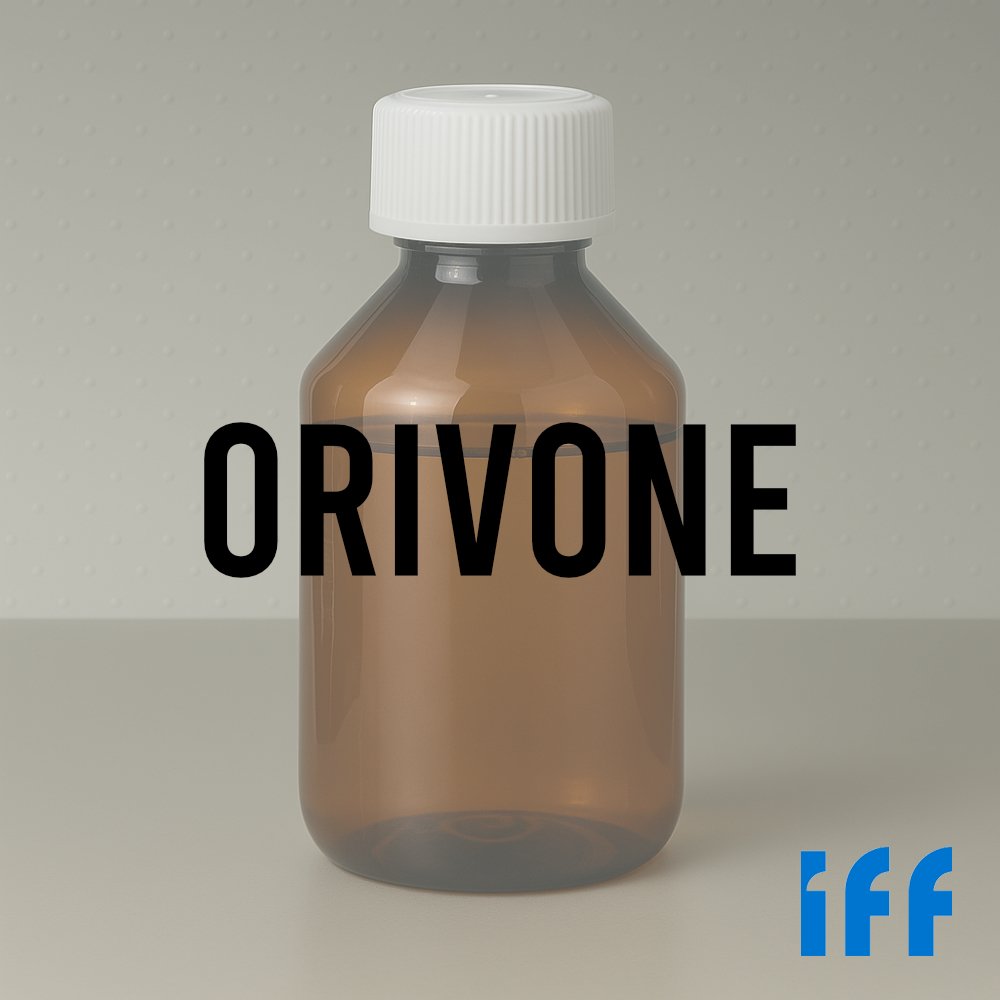 Image 2 of 2
Orivone (CAS 16587-71-6) - Technical Ingredient Overview
🏭 Manufacturer — IFF (International Flavors & Fragrances)
🔎 Chemical Name — 4-(2-Methylbutan-2-yl)cyclohexan-1-one
🧪 Synonyms — 4-tert-Pentylcyclohexanone, 4-tert-Amylcyclohexanone, Cyclohexanone 4-(1,1-dimethylpropyl)-, Isopentylcyclohexanone
📂 CAS Number — 16587-71-6
📘 FEMA Number — Not assigned (not approved for flavor use)
⚖️ Molecular Weight — 168.28 g/mol
🧬 Molecular Formula — C₁₁H₂₀O
📝 Odor Type — Floral-woody, orris
📈 Odor Strength — Very high (powerful, diffusive)
👃🏼 Odor Profile — Powerful orris-type aroma with woody-camphoraceous character; slightly earthy with distinct iris-violet facets; powdery, dry, and highly diffusive with subtle raspberry and pine undertones
⚗️ Uses — Floral compositions (especially iris/violet accords), powdery bases, woody-floral blends, soap perfumery, laundry detergents, functional fragrances
🧴 Appearance — Colorless to pale yellow clear liquid
What is Orivone?
Orivone is a synthetic cycloaliphatic ketone developed by IFF (International Flavors & Fragrances) to replicate the characteristic powdery-floral aroma of natural orris root (iris rhizomes). Structurally, it is a cyclohexanone derivative featuring a tertiary pentyl (tert-amyl) substituent at the 4-position of the cyclohexanone ring.
Unlike natural orris products—which derive their scent from irones (methylated ionone derivatives formed during the aging of iris rhizomes)—Orivone belongs to a different chemical family. It is not an ionone but rather a cycloaliphatic ketone. Despite this structural difference, Orivone successfully captures key olfactory aspects of orris, particularly its woody-camphoraceous, earthy, and powdery-floral character, making it a cost-effective alternative to expensive natural orris butter and orris absolute (Surburg & Panten, 2006).
Orivone is valued in perfumery for its exceptional diffusivity and power, allowing perfumers to achieve orris effects at low concentrations. It demonstrates excellent soap stability and compatibility with ionones, lavandin oil, and other floral materials, making it particularly useful in functional perfumery applications (Arctander, 1969).
Historical Background
Orivone was developed by IFF in the mid-20th century as part of the fragrance industry’s ongoing effort to create synthetic substitutes for rare and expensive natural materials. Natural orris products (orris butter, orris absolute, orris resinoid) are derived from the rhizomes of Iris pallida, I. germanica, and I. florentina, which require 3 years of growth followed by 3 years of aging before extraction—a process that makes them among the most expensive natural perfumery materials.
The commercial introduction of Orivone provided perfumers with an economical and reliable orris-type material that could be used in high concentrations in soap and detergent formulations—applications where natural orris would be prohibitively expensive. The compound’s development coincided with the post-war expansion of synthetic organic chemistry in perfumery, when major fragrance houses systematically explored cycloaliphatic ketones and alcohols for floral effects.
Steffen Arctander (1969) described Orivone as having a “very powerful, diffusive, woody-camphoraceous odor, slightly earthy, yet with some resemblance to Orris root, overall very dry,” noting that it “finds extensive use in perfumery, at low concentration, for its power, soap stability and compatibility with Ionones, Lavandin oil, etc.”
The synthesis of Orivone is achieved through catalytic hydrogenation of p-tert-amylphenol over palladium in the presence of borax, a relatively straightforward process that allows for consistent quality and economical production (Surburg & Panten, 2006).
Olfactory Profile
Scent Family: Floral-woody, orris-type
Main Descriptors:
Orivone delivers a distinctive orris-like aroma characterized by:
Woody-camphoraceous core with dry, penetrating character
Powdery-floral violet-iris nuances reminiscent of natural orris butter
Earthy and slightly green undertones with clay-like qualities
Subtle raspberry and fruity facets in dilution
Pine-like, fresh aspects with mild resinous character
Overall impression: dry, diffusive, radiant, and sophisticated
Intensity: Very high — extremely powerful and diffusive; effective at concentrations as low as 0.1–1% in finished compositions
Tenacity: Moderate to high — provides lasting woody-floral base that supports top and middle notes without overpowering
Volatility: Medium — functions as a heart-to-base note material, bridging volatile florals and substantive woods
Fixative Role: While not a traditional fixative, Orivone enhances longevity and diffusion of floral compositions, particularly violet and iris accords. Its powerful nature helps to amplify and extend the projection of delicate floral notes.
Applications in Fine Fragrance
Orivone is widely used in perfumery as an economical orris substitute and floral modifier. Key applications include:
Floral Compositions:
Iris and violet accords — provides authentic orris character at a fraction of the cost of natural materials
Powdery florals — enhances muguet (lily of the valley), freesia, and soft rose compositions
Vintage-style florals — contributes to classic powdery-aldehydic structures
Woody-Floral Blends:
Adds softness and roundness to woody bases without compromising structure
Bridges citrus top notes and warm woody hearts for seamless transitions
Complements cedarwood, sandalwood, and patchouli with elegant floral lift
Pairing Behavior:
Ionones (α-, β-ionone) — natural compatibility creates rich, complex iris effects
Coumarin and heliotropin — enhances powdery-sweet accords
Lavandin and lavender — provides floral depth and sophistication
Musks (galaxolide, cashmeran) — adds softness and diffusion to musky bases
Irones (α-, γ-irone) — can be blended with natural orris components for cost optimization
Performance in Formula
Usage Levels: Orivone is extremely potent and typically used at 0.1–2% in fine fragrance concentrates. In functional applications (soaps, detergents), it may be used at higher levels (2–5%) due to its excellent stability.
Stability:
Soap stability — exceptional resistance to alkaline conditions, making it ideal for soap perfumery
Oxidative stability — maintains olfactory integrity under various storage conditions
Heat stability — suitable for applications requiring moderate heat processing
Blending Considerations:
Use in low concentrations to avoid overwhelming compositions with its camphoraceous aspects
Works best when diluted to allow powdery-floral facets to emerge
Highly diffusive — a little goes a long way; start with minimal dosage and adjust upward
Compatible with both natural and synthetic materials without reactivity issues
Industrial & Technical Uses
Beyond fine fragrance, Orivone is extensively used in:
Functional Perfumery:
Laundry detergents — provides lasting orris-floral freshness with excellent wash stability
Fabric softeners — contributes soft, powdery character to fabric care products
Bar soaps and liquid soaps — maintains olfactory profile in alkaline conditions
Shampoos and body washes — adds elegant floral lift to personal care formulations
Home Care:
All-purpose cleaners — masks chemical odors with pleasant floral-woody notes
Air fresheners — provides long-lasting diffusive orris character
Candles — contributes sophisticated floral-woody base notes
Orivone is not approved for use in flavoring and has no FEMA GRAS status.
Regulatory & Safety Overview
IFRA Status:
No restrictions under IFRA 51st Amendment across all product categories
Not listed among restricted or specified substances
Can be used without category-specific limitations
IFRA Standards Library: https://ifrafragrance.org/standards-library
EU Cosmetics Regulation (EC 1223/2009):
Permitted for use in cosmetic products
Not listed among the 26 allergenic fragrance substances requiring mandatory declaration on product labels
Compliance maintained when used according to good manufacturing practices
GHS Classification:
Based on available safety data:
H302 — Harmful if swallowed (oral toxicity, mildly toxic by ingestion)
H319 — Causes serious eye irritation
H372 — Causes damage to organs through prolonged or repeated exposure
H410 — Very toxic to aquatic life with long-lasting effects
FEMA Status:
Not assigned — Orivone has not been evaluated or approved for use in food flavoring applications.
Toxicology:
Orivone is classified as mildly toxic by ingestion and is a skin irritant in concentrated form. Standard safety precautions for handling aromachemicals should be observed, including use of protective equipment and adequate ventilation. The compound demonstrates low sensitization potential at typical use concentrations in finished products. Environmental considerations include its classification as very toxic to aquatic life, requiring proper disposal practices (GHS classification data).
INCI Name: ISOPENTYLCYCLOHEXANONE
Synthesis & Production
Orivone is produced through catalytic hydrogenation of 4-tert-amylphenol (p-tert-amylphenol) over a palladium catalyst in the presence of borax as a co-catalyst. This process achieves:
High yield and purity suitable for perfumery applications
Consistent quality with reproducible olfactory profile
Economic viability compared to natural orris extraction
The synthesis follows established methods for converting alkyl-substituted phenols to the corresponding cyclohexanones, a common approach in aroma chemical manufacturing (Surburg & Panten, 2006).
References
Arctander, S. (1969). Perfume and flavor materials of natural origin. Self-published.
Surburg, H., & Panten, J. (2006). Common fragrance and flavor materials: Preparation, properties and uses (5th ed.). Wiley-VCH.
IFF. (2025). Orivone — Technical product documentation. International Flavors & Fragrances. Retrieved from https://www.iff.com/scent/ingredients-compendium/orivone/
Boix Camps, A. (n.d.). Personal communication on orris-type materials. Cited in Pellwall Perfumes product documentation.
IFRA. (2023). 51st Amendment to the IFRA Standards. International Fragrance Association. https://ifrafragrance.org/standards-library
European Chemicals Agency (ECHA). (2023). Substance information: 4-tert-Pentylcyclohexanone. Retrieved from https://echa.europa.eu/