 Image 1 of 2
 Image 2 of 2
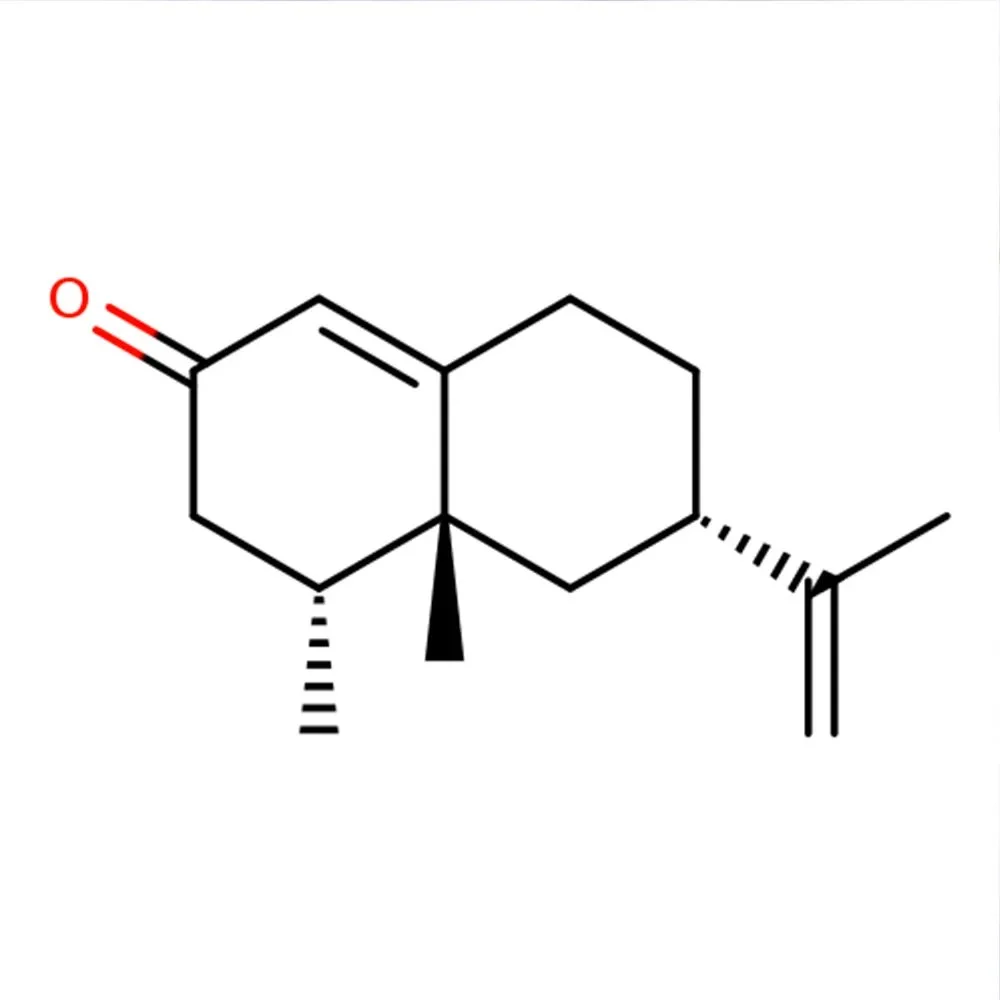
Nootkatone (CAS 4674-50-4) Technical Ingredient Overview
🔎 IUPAC Name — (4R,4aS,6R)-4,4a,5,6,7,8-hexahydro-4,4a-dimethyl-6-(1-methylethenyl)-2(3H)-naphthalenone
🧪 Synonyms — (+)-Nootkatone, 1(10)-Aromadendren-9(10)-one, 6-Isopropenyl-4,4a-dimethyl-4,4a,5,6,7,8-hexahydronaphthalen-2(3H)-one
🧬 Chemical Formula — C₁₅H₂₂O
📂 CAS Number — 4674-50-4
📘 FEMA Number — 3166 (pure); 4941 (nootkatone complex ≥60%)
⚖️ Molecular Weight — 218.33 g/mol
🌡️ Melting Point — 34-38°C
📝 Odor Type — Zesty Citrus / Woody
📈 Odor Strength — Very high (odor threshold ≈ 800 ppb in water)
📊 Log P — 3.8
💨 Vapor Pressure — 0.001183 mm Hg @ 23°C
🕐 Substantivity — >48 hours
👃🏼 Odor Profile — Powerful grapefruit peel, zesty citrus, woody, vetiver, green, earthy, herbal, tobacco-like
👅 Flavor Profile — Grapefruit-like at 0.1–0.3 ppm; perceptible in beverages at 0.3 ppm; bitterness increases above 50 ppm
⚗️ Primary Uses — Citrus enhancement, grapefruit reconstructions, woody-vetiver profiles, tropical-tobacco modifiers, insect repellent
🧴 Appearance — White to pale yellow crystalline solid or oily liquid (orange-tinted in commercial grades)
What is Nootkatone?
Nootkatone is a bicyclic conjugated sesquiterpene ketone belonging to the eremophilane structural class. Though it occurs naturally in grapefruit peel oil (~0.3-2%), Alaska yellow cedar heartwood, vetiver grass, and trace amounts in other plants, its commercial form is predominantly produced synthetically via oxidation of valencene—a more abundant sesquiterpene extracted from orange peel oil (typically present at ≤0.4%).
The molecule possesses three asymmetric carbon centers, with the (+)-enantiomer being the naturally occurring and commercially relevant form. Both enantiomers exhibit similar olfactory characteristics, and racemic mixtures are occasionally used when synthesized from racemic valencene.
Historical Background
Discovery and Naming
Nootkatone was first isolated and structurally characterized in 1962 by Erdtman and Hirose from the heartwood of Chamaecyparis nootkatensis (Alaska yellow cedar, also called Nootka cypress or Nootka cedar). The species name nootkatensis derives from the Nuu-Chah-Nulth people of Canada (formerly referred to as the Nootka people), whose territory included Nootka Sound on Vancouver Island—an area first documented by European explorers in 1778 during Captain James Cook's third voyage aboard HMS Resolution.
The tree itself, despite common names including "cedar," is actually a cypress species in the Cupressaceae family, native to coastal mountains of the Pacific Northwest from Alaska's Kenai Peninsula to northern California's Klamath Mountains.
Early Research and Grapefruit Connection
Following its initial isolation from Alaska yellow cedar, MacLeod and Buigues identified nootkatone in grapefruit peel oil in 1964, establishing its role as the principal aroma compound responsible for grapefruit's characteristic scent. This discovery positioned nootkatone as one of the most valuable citrus flavor compounds, though its low natural abundance (trace to 2% in grapefruit oil) made extraction economically challenging.
Commercial Development
The mid-20th century saw increasing demand for nootkatone in flavor and fragrance applications. Chemical synthesis routes were developed, initially using harsh oxidizing agents like tertiary-butyl chromate on valencene. Modern production has shifted toward:
Bioconversion processes using engineered enzymes (Evolva, Lallemand patents)
Fermentation technologies allowing "natural" classification under food regulations
Enzymatic oxidation via cytochrome P450, laccases, and lipoxygenases
These biotechnological advances have made nootkatone more accessible and sustainable.
Insect Repellent Discovery
The CDC (Centers for Disease Control and Prevention) discovered nootkatone's arthropod repellent properties approximately 25 years ago during research into plant-based pest control compounds. On August 10, 2020, the U.S. EPA approved and registered nootkatone as an arthropod repellent, effective against deer ticks, lone star ticks, mosquitoes, bed bugs, and lice.
Olfactory Profile
Scent Family
Zesty citrus-woody with green-earthy undertones
Main Descriptors
Top Note: Extremely powerful, zesty grapefruit peel, fresh citrus sparkle
Heart Note: Woody-vetiver character, green-earthy herbaceous nuances
Base Note: Subtle tobacco-like dryness, mild balsamic warmth
Detailed Character:
Nootkatone delivers an immediately recognizable, high-impact grapefruit character that combines bright citrus freshness with surprising depth. Unlike simple citrus oils, it provides both the zesty top-note brightness and a woody, almost resinous foundation that extends wear and complexity. The molecule's unique profile includes subtle green-earthy facets reminiscent of vetiver, with faint herbal and tobacco-like undertones that emerge as the scent develops.
Intensity & Performance
Odor Strength: Very high; perceptible at ~800 ppb in water
Impact: Top note (high), Heart note (high)
Tenacity: Exceptional for a citrus material; >48 hours substantivity
Diffusion: Strong radiance with persistent character
Volatility: Moderate; maintains presence through multiple stages
Applications in Fine Fragrance
Functional Roles in Formulation
Top-Note Applications:
High-impact grapefruit and bitter orange reconstructions
Modern citrus cologne compositions
Zesty freshness in ozonic-fruity fragrances
Tropical fruit accords (passion fruit, mango, guava)
Heart-to-Base Applications:
Woody-vetiver depth in masculine fragrances
Green-earthy complexity in chypres
Tobacco-aromatic modifiers in fougères
Subtle herbal-woody support in modern aromatic compositions
Typical Usage Levels:
Fine Fragrance: Traces to 2%
Citrus Reconstructions: 0.5-2%
Functional Products: 0.1-1%
Specialty Applications: Variable based on effect
Synergistic Combinations
Citrus Enhancers:
Bergamot oil, grapefruit oil, lime oil
Limettal, aldehydes (C10-C12)
Amarocit (methyl pamplemousse)
Woody-Green Pairings:
Vetiver, cedarwood, patchouli
Isobornyl acetate, hexenyl esters
Ambrettolide, hedione
Fruity-Tropical Blends:
Hexyl acetate, hexenyl butyrate
Passion fruit bases, mango specialties
Tropical esters and lactones
Industrial & Technical Uses
Flavor Industry (FEMA 3166, 4941)
Grapefruit flavor in beverages, soft drinks, carbonated drinks
Confectionery and chewing gum applications
Citrus-flavored food products
Bitter flavor modulation at controlled levels
Insect Repellency (EPA Approved 2020)
Proven efficacy against deer ticks (Ixodes scapularis), lone star ticks (Amblyomma americanum)
Effective mosquito repellent
Bed bug and lice control applications
Mechanism: Activates α-adrenergic type 1 octopamine receptor (PaOA1) in arthropods, causing fatal spasms
Pharmaceutical & Cosmetic Applications
Low dermal toxicity profile permits use in personal care
Antioxidant and anti-inflammatory properties documented
Inhibitory effects on acetylcholinesterase and cytochrome P450 enzymes
Potential pharmaceutical applications under investigation
Production Methods
Natural Extraction:
From grapefruit peel oil (~0.3-2% content)
From Alaska yellow cedar heartwood
Economic limitations due to low yield
Chemical Synthesis:
Valencene oxidation using CrO₃, oxygen + metal salts, or other oxidizing agents
Various synthetic routes from dimethyl γ-ketopimelate, cyclohexane derivatives, (+)-nopinone
Biotechnological Production:
Enzymatic oxidation of valencene using cytochrome P450 enzymes
Fermentation using engineered Saccharomyces cerevisiae, Escherichia coli
Laccase-catalyzed oxidation with mediators
Lipoxygenase-based bioconversion
Evolva/Lallemand patented processes enable "natural" classification under current food legislation
Regulatory & Safety Overview
IFRA Status: Not restricted under IFRA 51st Amendment; recommended to follow general sesquiterpene ketone guidelines
EU Allergens: Not listed among the 26 declarable fragrance allergens under EC Regulation 1223/2009
FEMA GRAS:
FEMA 3166: Pure (+)-nootkatone; recognized as safe for flavor use
FEMA 4941: Nootkatone complex (≥60% nootkatone from fermentation)
EPA Registration: Approved as insect repellent (August 10, 2020)
ECHA (REACH): Registered; not classified as hazardous under CLP
Sustainability:
100% renewable when biotech-derived
Natural-derived classification available
Vegan suitable
Readily biodegradable
Non-persistent in environment
Not classified as PBT or vPvB
Toxicology:
No sensitization, genotoxicity, or phototoxicity in standard testing
Low oral and dermal toxicity
Safe for use in foods, fragrances, cosmetics, and repellents
Safety Conclusion: ✅ Considered safe and sustainable for perfumery, flavor, insect repellent, and environmental applications under current regulatory frameworks.
References
Andersen, N. H. (1970). Studies on the natural occurrence of eremophilane-type sesquiterpenes. Phytochemistry, 9(1), 145-151.
Arctander, S. (1969). Perfume and Flavor Chemicals (Aroma Chemicals). Self-published, Montclair, NJ.
Erdtman, H., & Hirose, Y. (1962). The chemistry of the natural order Cupressales. 41. The chemical composition of the heartwood of Cupressus nootkatensis. Acta Chemica Scandinavica, 16, 1311-1314.
Fan, J., Liu, Z., Xu, S., Yan, X., Cheng, W., Yang, R., & Guo, Y. (2022). Non-food bioactive product (+)-nootkatone: Chemistry and biological activities. Industrial Crops and Products, 176, 114327.
FEMA (Flavor and Extract Manufacturers Association). (2024). FEMA GRAS Database – FEMA No. 3166, 4941. Retrieved from https://www.femaflavor.org
IFF. (2025). Nootkatone Crystals: Ingredients Compendium. Retrieved from https://www.iff.com/scent/ingredients-compendium/nootkatone-crystals/
Leffingwell, J. C. (2002). The Nootkatones. Leffingwell Reports, 2(5), 1-14.
MacLeod, W. D., Jr., & Buigues, N. M. (1964). Sesquiterpenes. I. Nootkatone, a new grapefruit flavor constituent. Journal of Food Science, 29(5), 565-568.
PubChem. (2025). Compound Summary for CID 1268142 (Nootkatone). National Center for Biotechnology Information. Retrieved from https://pubchem.ncbi.nlm.nih.gov/compound/1268142
Sell, C. S. (2014). A Fragrant Introduction to Terpenoid Chemistry. Royal Society of Chemistry.
U.S. Environmental Protection Agency. (2020). EPA Registers Nootkatone as New Active Ingredient. EPA Press Release, August 10, 2020.
Wriessnegger, T., Augustin, P., Engleder, M., Leitner, E., Müller, M., Kaluzna, I., ... & Pichler, H. (2016). Production of the sesquiterpenoid (+)-nootkatone by metabolic engineering of Pichia pastoris. Metabolic Engineering, 24, 18-29.