 Image 1 of 1
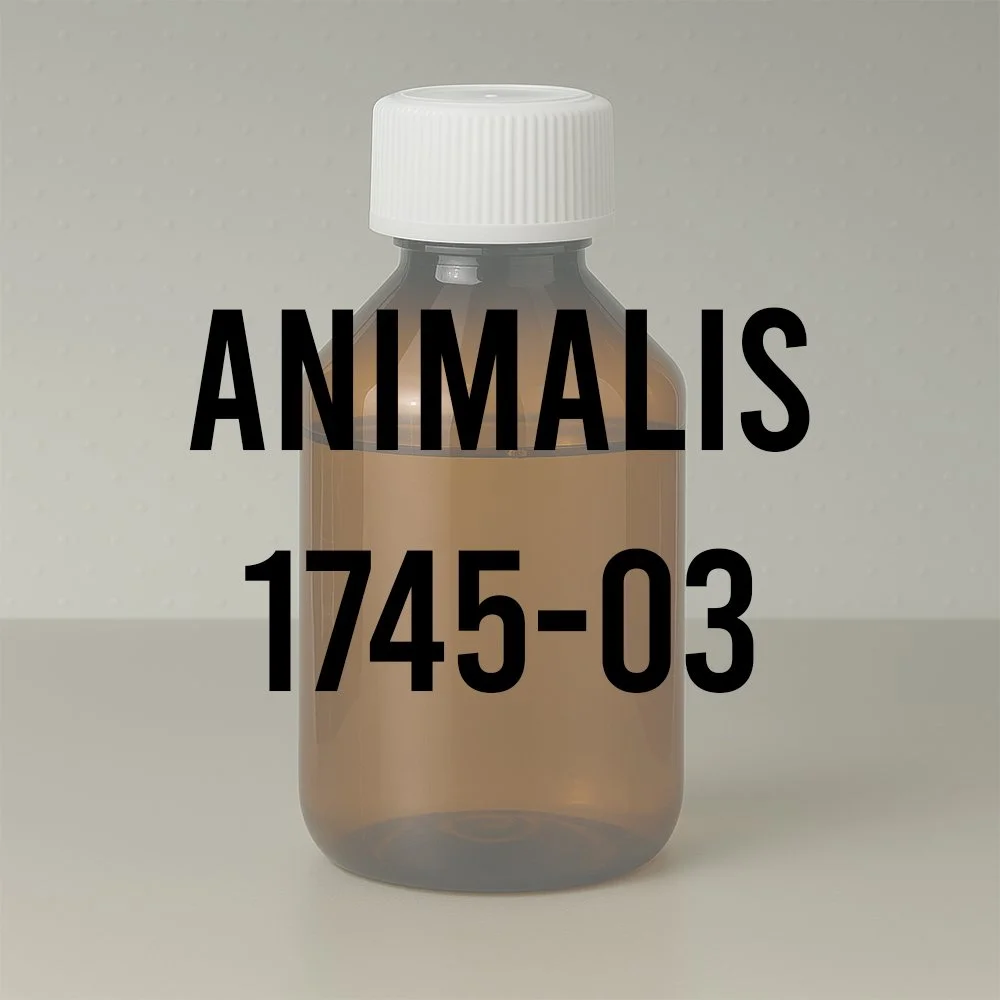
Animalis 1745-03 Technical Ingredient Overview
🏭 Manufacturer — Synarome (founded 1926, now part of Sozio Group)
🔎 Chemical Name — Proprietary perfumer's base (complex blend)
🧪 Synonyms — Animalis Base, Animalis 1745-03, Animalis Tonkin type
📂 CAS Number — Mixture (not applicable for perfumer's bases)
📘 FEMA Number — Not applicable (fragrance base, not approved for flavor use)
⚖️ Molecular Weight — Variable (complex mixture)
📝 Odor Type — Animalic
📈 Odor Strength — Very powerful and substantive
👃🏼 Odor Profile — Warm, powerful Tonkin musk character with pronounced leathery facets; dominant animalic elements infused with strong woody and leathery warmth; honey-like nuances with distinctive animalic depth
⚗️ Uses — Fine fragrance (particularly masculine and Oriental compositions), citrus fragrances (to enhance fresh notes), leather accords, chypre compositions; acts as powerful fixative
🧴 Appearance — Thick, dense ambery-yellow liquid; mostly insoluble in water but readily soluble in alcohol
What is Animalis 1745-03?
Animalis 1745-03 is one of the most iconic perfumer's bases in the fragrance industry, created by Synarome to replicate the rich, warm animalic notes of natural Tonkin musk and civet. Originally developed to bring Musk Tonkin and civet notes to perfumes, Animalis has a powerful temperament expressed by dominant animalic elements, infused with a strong woody and leathery warmth.
A perfumer's base is a pre-composed blend of complementary ingredients designed to create a unified olfactory effect, allowing perfumers to efficiently incorporate complex note structures without reconstructing them from individual components. Animalis has been used extensively since the 1950s, particularly in masculine fragrances for its distinctive leather character.
Historical Background
Synarome was founded in 1926 by brothers Hubert and Georges Fraysse in Asnières near Paris, where most major fragrance houses were located at the time. The Fraysse family had deep roots in perfumery: their father, Claude Fraysse, was a chemical engineer who collaborated with Philippe Chuitt of Firmenich and Mr. Givaudan on the development of ionones and methyl ionones in the late 19th century.
Among Synarome's most famous specialties are natural raw material substitutes including Ambrarome (the first specialty created by Hubert in 1926 to replace ambergris), Animalis, and Muscarome. These groundbreaking bases established Synarome as an iconic company in the fragrance industry.
The development of Animalis was particularly significant as it emerged during a period when ethical concerns, supply constraints, and cost considerations made natural animalic materials increasingly problematic. Natural musk derived from the Tibetan musk deer (Moschus moschiferus) and civet from the civet cat (Civettictis civetta) were traditionally used but involved animal cruelty and threatened species survival.
In 2021, Sozio acquired Synarome, strengthening its position in organic synthesis, perfumery specialties, and distillation for the fragrance industry. Today, Synarome operates from Chartres in the heart of France's Cosmetic Valley, where all products are manufactured.
Important Note: Synarome currently produces two distinct Animalis bases: Animalis 1745-03 (which is Tonkin musk-like, very warm and musky with leathery nuance) and Animalis 5853 (with woody and more sensuous notes, where the soft leather note is emphasized and the total effect is more delicate). This overview focuses on Animalis 1745-03, the more robust and animalic of the two.
Olfactory Profile
Scent Family: Animalic-Musky with Leather facets
Main Descriptors:
The olfactory profile presents a complex evolution from sharp, high-pitched top notes to warm, sweet drydown. The odor decreases through layers of musk, animalic, leathery, and costus characteristics, remaining powerful and substantive throughout. The base straddles the line between beastly notes of animal origin—castoreum, civet, hyrax, musks—and animalic floral notes featuring para-cresyl compounds and indole.
The modern formulation achieves its animalic character through sophisticated synthetic reconstruction rather than animal-derived materials. Key components include 10-undecanal, linalool, alpha-pinene, β-caryophyllene, limonene, and substantial amounts of cedrol and alpha-cedrene. The main aromatic component is para-cresyl phenyl acetate, often combined with costus to achieve the full animalic effect.
Intensity: Very high odor strength with exceptional diffusive power; described as "beastly throughout" with considerable projection
Tenacity: Exceptionally long-lasting with excellent fixative properties; the base's stability allows use not only in fine fragrance but also in shampoo, deodorant, and creams
Volatility: Base note character with very low volatility; acts as powerful fixative to anchor more volatile top and heart notes
Fixative Role: Highly substantive and acts as an excellent fixative product, prolonging the duration of fragrance compositions while adding characteristic depth
Applications in Fine Fragrance
Animalis has been the most widely used animalic base since the 1950s, especially in masculine fragrances for its leather character. The specialty is mostly used in Oriental compositions and in citrus fragrances to enhance fresh notes.
Notable Uses:
The base is featured in iconic fragrances including Yves Saint Laurent's Kouros and Hugo Boss #1. It has been used to "dirty up" masculine fougère accords in overdose and to add texture and personality to classic 1940s floral perfumes for women. Modern perfumes featuring Animalis include Vierge et Toreros by Etat Libre d'Orange and possibly Twill Rose by Parfums de Rosine.
Typical Accords and Combinations:
Animalis pairs exceptionally well with isobutyl quinoline, galbanum, and hyacinth notes, and is always valuable in classic chypre fragrances. It blends very well in all perfumes, especially with opulent flowers like tuberose and peony, agarwood, leathers, and sandalwood. The combination with vanillin creates effects reminiscent of Guerlain's Shalimar base structure.
Pairing Behavior:
When combined with costus root essential oil, the animalic effect is dramatically intensified. The base works particularly well in bridging floral notes with woody-ambery structures, providing depth and radiance that makes floral essences "bloom" on the skin.
Performance in Formula
The base exhibits remarkable stability across various product matrices. Its stability has allowed it to be featured not only in fine fragrance but also in functional products including shampoo, deodorant, and creams. This versatility is unusual for such a powerful and characterful material.
Recommended Usage Level:
Perfumers recommend using Animalis in traces across formulations to provide a subtle "French je ne sais quoi" quality. However, historical uses show ranges from trace amounts up to intentional overdoses to create deliberately "dirty" or provocative compositions.
Blending Behavior:
The base tends to "grow" in perfume compositions over time, so well-aged dilutions are less capricious and easier to work with. Perfumers should account for this developmental character during formulation and maturation periods.
Industrial & Technical Uses
Synarome creates and manufactures more than 200 aroma chemicals and specialties for the global fragrance and flavor industry through various processes including acetylations, acetal formations, cyanation, and transesterification.
Animalis 1745-03 is primarily used in fine fragrance applications rather than industrial or technical applications outside perfumery. Its exceptional stability allows incorporation into personal care products including shampoos, deodorants, and creams where its fixative properties and characteristic warmth enhance product performance.
The base is manufactured using sophisticated organic chemistry and blending techniques at Synarome's facility in Chartres, France, where products undergo rigorous quality control including GC-MS analysis, relative density measurements, refractive index testing, and olfactory evaluation by master perfumers.
Regulatory & Safety Overview
IFRA Status:
Modern Animalis 1745-03 formulations are designed to comply at 100% with current IFRA regulations by using synthetic alternatives rather than prohibited natural materials. The specialty contains no animal products despite its animalic character.
EU Cosmetics Regulation: Compliant when used within IFRA-recommended limits; no prohibited ingredients in modern formulations
FEMA Status: Not applicable—Animalis is a fragrance-only material not approved for flavor applications
References
Arctander, S. (1960). Perfume and Flavor Materials of Natural Origin. Elizabeth, NJ: Arctander.
Calkin, R. R., & Jellinek, J. S. (1994). Perfumery: Practice and Principles. New York: Wiley.
Curtis, T., & Williams, D. G. (2001). An Introduction to Perfumery (2nd ed.). Micelle Press.
Kraft, P. (2004). Aroma chemicals IV: Musks. In D. J. Rowe (Ed.), Chemistry and Technology of Flavors and Fragrances (pp. 143-168). Oxford: Blackwell Publishing.
Pybus, D., & Sell, C. (Eds.). (1999). The Chemistry of Fragrances. Cambridge: Royal Society of Chemistry.
Rowe, D. J. (Ed.). (2004). Chemistry and Technology of Flavors and Fragrances. Oxford: Blackwell Publishing.
Surburg, H., & Panten, J. (2006). Common Fragrance and Flavor Materials: Preparation, Properties and Uses (5th ed.). Weinheim: Wiley-VCH.
Synarome. (2025). Iconic Ingredients. Retrieved from https://synarome.com/iconic-products/
International Fragrance Association. (2024). IFRA Standards—51st Amendment. Retrieved from https://ifrafragrance.org/
PubChem. (2025). p-Cresyl phenylacetate [CID 60997]. National Library of Medicine. Retrieved from https://pubchem.ncbi.nlm.nih.gov/compound/60997