Image 1 of 2
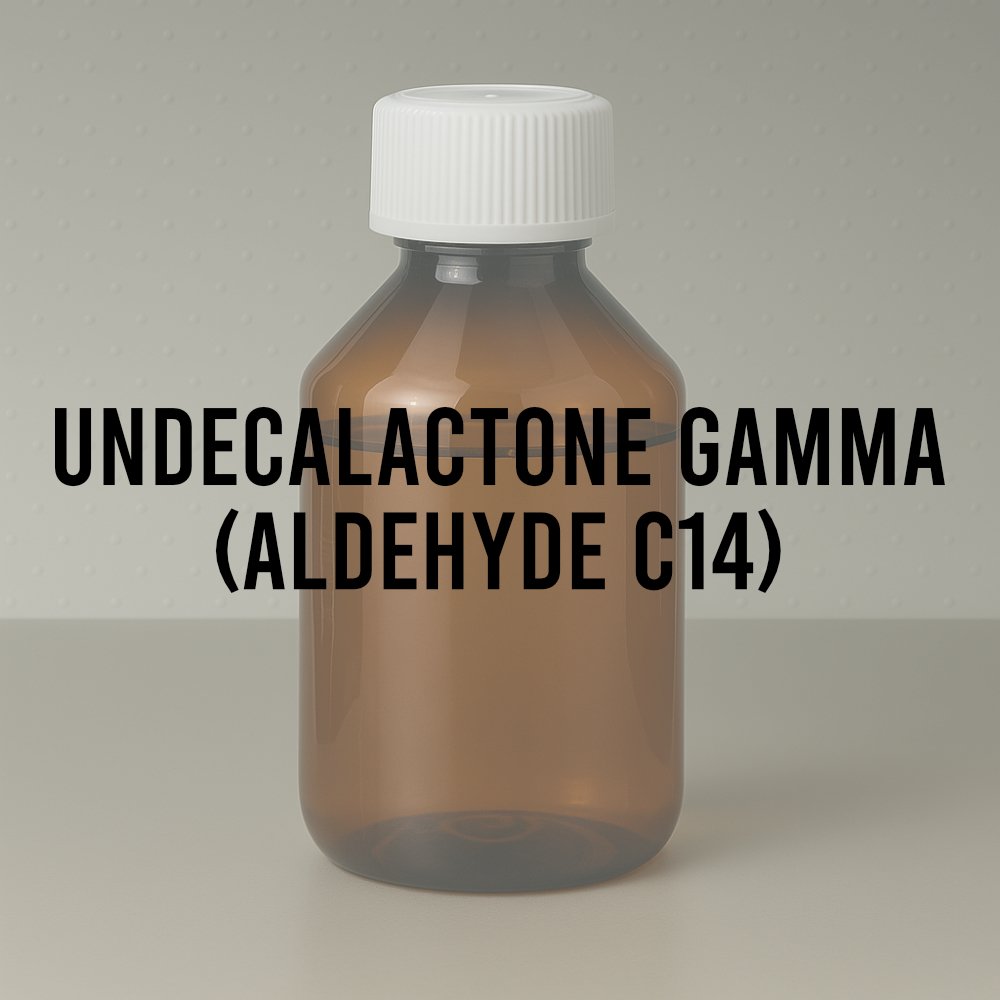 Image 2 of 2
Undecalactone Gamma (γ-Undecalactone) Technical Ingredient Overview
🏭 Manufacturer — Available from multiple fragrance houses (Firmenich, Givaudan, IFF, Symrise)
🔎 Chemical Name — 5-Heptyloxolan-2-one (IUPAC); Undecan-4-olide
🧪 Synonyms — Aldehyde C-14 (trade misnomer), Peach Aldehyde, γ-Heptyl-γ-butyrolactone, 4-Undecanolide, Persicol, 5-Heptyldihydro-2(3H)-furanone, Undecanoic γ-lactone
📂 CAS Number — 104-67-6
📘 FEMA Number — 3091 (GRAS status for food flavoring)
⚖️ Molecular Weight — 184.28 g/mol
📝 Odor Type — Fruity-lactonic
📈 Odor Strength — Very high (detectable at extremely low concentrations)
👃🏼 Odor Profile — Rich, creamy peach-like aroma with fatty, lactonic undertones; soft nutty and tropical nuances; apricot, coconut, and vanilla facets. Extremely tenacious and influential even at very low concentrations
⚗️ Uses — Fine fragrance (floral-fruity accords, aldehydic compositions), flavor industry (peach, apricot, pear, maple, coconut, tropical, butterscotch flavors), personal care products, home fragrance
🧴 Appearance — Colorless to pale yellow clear liquid
What is Undecalactone Gamma?
Undecalactone Gamma (γ-undecalactone) is an 11-carbon γ-lactone characterized by a five-membered cyclic ester ring with an n-heptyl side chain. Despite its common trade name "Aldehyde C-14," this designation is a historical misnomer—the compound is structurally a lactone, not an aldehyde (Pybus & Sell, 2018). The "C-14" reference derives from early perfumery nomenclature and does not reflect its actual molecular structure.
This synthetic aroma chemical delivers a signature peach-like scent with creamy, fatty, and lactonic characteristics. It represents one of the most important lactones in modern perfumery, offering exceptional tenacity and olfactory impact at remarkably low concentrations.
Historical Background
γ-Undecalactone was first synthesized in 1908 by Russian chemists Jukov and Schestakow, marking an early milestone in synthetic fragrance chemistry. The material gained significant industry attention during the early 20th century for its ability to impart authentic fruity-peach notes to compositions.
The lactone achieved iconic status through its prominent use in Jacques Guerlain's masterpiece Mitsouko (1919), where it contributed to the revolutionary chypré-fruity structure. During the 1920s-1940s, it became a staple in violet and floral compositions by prestigious houses including Caron and Poiret.
The widespread adoption of γ-undecalactone accelerated dramatically during the 1950s, coinciding with the era of lactonic-musk-heavy perfumes and the development of new synthetic musks. This period established the material as an essential tool for creating diffusive, sweet, and realistic fruity effects in both fine fragrance and flavor applications (Arctander, 1969).
Olfactory Profile
Scent Family
Lactonic-Fruity, positioned within the broader fruity olfactory family
Main Descriptors
Primary: Peach, apricot, creamy
Secondary: Fatty, lactonic, coconut
Tertiary: Nutty, tropical, vanilla, sweet
Intensity
Extremely potent—effective at concentrations as low as 0.01-0.2% in fine fragrance compositions. Overdosing above 0.2% can easily overload a blend due to its oily intensity and persistent character.
Tenacity
Exceptional longevity, lasting over 340 hours on smelling strips. Functions primarily as a middle-to-base note modifier despite its initial fruity impact.
Volatility
Medium volatility—bridges top and middle notes while providing substantial base persistence. Evaporation rate positions it as a middle note with strong fixative properties.
Fixative Role
Acts as an effective fixative due to high tenacity and low volatility. Enhances diffusion, sweetness, and overall perceived longevity of fragrance compositions.
Applications in Fine Fragrance
γ-Undecalactone serves as a cornerstone ingredient in floral-fruity accords, aldehydic compositions, and modern gourmand fragrances. Its primary applications include:
Peach & Apricot Accords: Delivers authentic stone fruit character
White Florals: Enhances gardenia, tuberose, and ylang-ylang compositions
Aldehydic Perfumes: Provides creamy sweetness and volume
Chypré Fragrances: Historical use in fruity chypré structures (Mitsouko)
Oriental Bases: Adds lactonic warmth and tropical facets
Typical Usage Level: 0.05-0.5% in fine fragrance concentrates
Performance in Formula
In blends, γ-undecalactone demonstrates excellent compatibility with:
Other lactones (γ-decalactone, δ-dodecalactone)
Ionones and methylionones
Vanillin and ethyl maltol
Salicylates and coumarin
Musks (particularly polycyclic and macrocyclic types)
Critical Note: Even at 0.01%, this material significantly impacts diffusion and perceived sweetness. Careful dosage control is essential—concentrations exceeding 0.2% risk overwhelming the composition with oily, fatty heaviness.
Industrial & Technical Uses
Beyond perfumery, γ-undecalactone finds extensive application in:
Food Flavoring: FEMA 3091 GRAS status; widely used in peach, apricot, pear, tropical fruit, butterscotch, and coconut flavors for beverages, dairy, bakery, and confectionery products
Personal Care: Shampoos, lotions, creams with fruity appeal
Home Fragrance: Candles, air fresheners, diffusers
Industrial Fragrance: Functional products requiring long-lasting fruity notes
Commercial Production: Industrially synthesized via acid-catalyzed lactonization of 10-undecylenic acid using 70-80% sulfuric acid, with migration of the double bond. Alternative routes include peroxide-catalyzed radical addition of 1-octanol to acrylic acid (Pybus & Sell, 2018).
Regulatory & Safety Overview
IFRA Status
IFRA Amendment 51 (June 2023): No restrictions for Category 4 (fine fragrance). IFRA Standards Documentation
EU Cosmetics Regulation
Compliant with EU Regulation 1223/2009 for use in cosmetic products. Not listed as a restricted substance.
FEMA Status
FEMA 3091 — GRAS (Generally Recognized As Safe) for use as a flavor ingredient. Approved under 21 CFR 172.515.
JECFA Number: 233
Toxicology
Safety profile established through comprehensive toxicological evaluation by FEMA and JECFA. The material has been thoroughly assessed for dermal sensitization, systemic toxicity, and mutagenicity. Studies demonstrate safety for intended uses at typical application levels (Adams et al., 1998).
Hazard Classification: H412 (Harmful to aquatic life with long-lasting effects) - Aquatic Chronic 3
References
Adams, T. B., Greer, D. B., Doull, J., Munro, I. C., Newberne, P. M., Portoghese, P. S., Smith, R. L., Wagner, B. M., Weil, C. S., Woods, L. A., & Ford, R. A. (1998). The FEMA GRAS assessment of lactones used as flavor ingredients. Food and Chemical Toxicology, 36, 249-278.
Arctander, S. (1969). Perfume and flavor chemicals (aroma chemicals). Published by the author.
Pybus, D. H., & Sell, C. S. (Eds.). (2018). The chemistry of fragrances: From perfumer to consumer (2nd ed.). Royal Society of Chemistry.
IFRA. (2023). 51st Amendment to the IFRA Standards. International Fragrance Association. https://ifrafragrance.org/