 Image 1 of 3
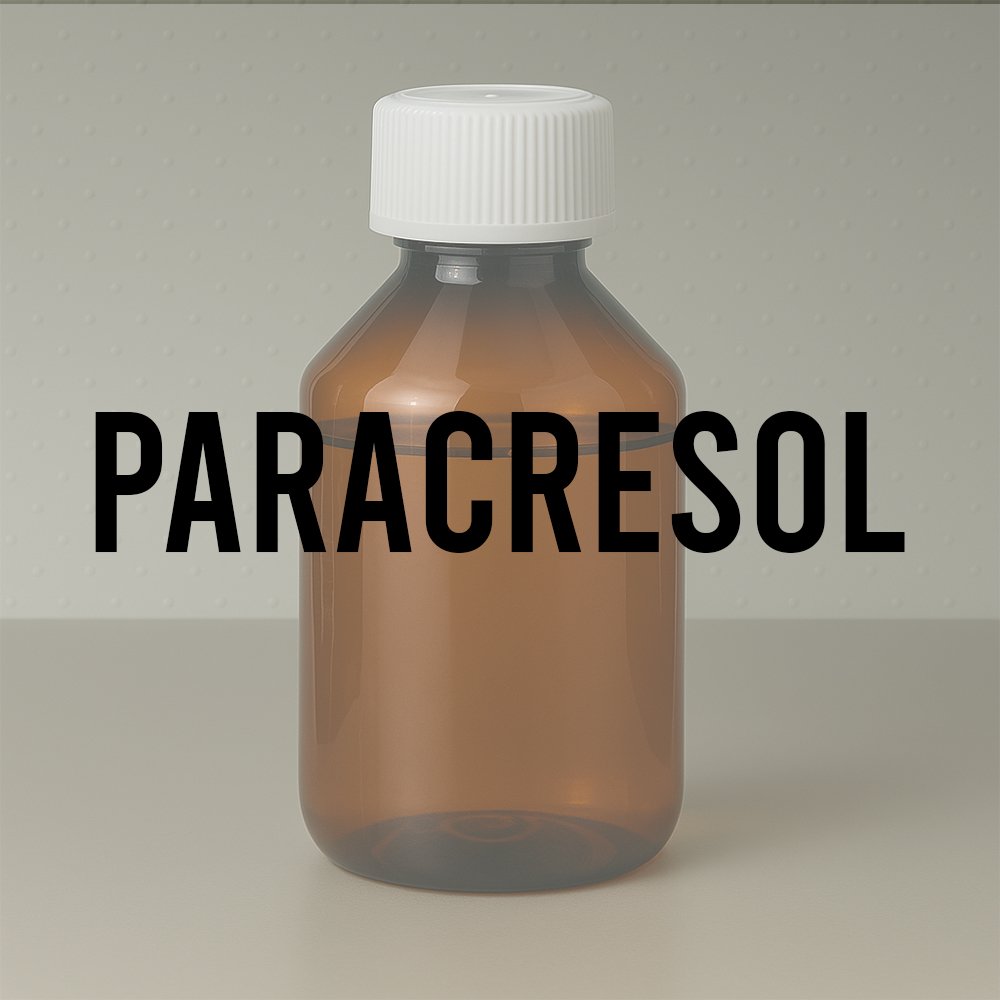 Image 2 of 3
 Image 3 of 3
Paracresol (CAS 106-44-5) - Technical Ingredient Overview
🏭 Manufacturer — Multiple producers (industrial-scale synthesis)
🔎 Chemical Name — 4-Methylphenol (para-Cresol, p-Cresol)
🧪 Synonyms — 4-Hydroxytoluene, 4-Cresol, para-Methylphenol, para-Oxytoluene, p-Tolyl alcohol, 1-Hydroxy-4-methylbenzene, Paracresol
📂 CAS Number — 106-44-5
📘 FEMA Number — 2337 (GRAS for flavor use under CFR §172.515)
⚖️ Molecular Weight — 108.14 g/mol
🧬 Molecular Formula — C₇H₈O (CH₃C₆H₄OH)
📝 Odor Type — Phenolic, animalic-floral
📈 Odor Strength — Extremely high (9–10/10) — among the most powerful fragrance materials
👃🏼 Odor Profile — Intensely phenolic, animalic, and medicinal at higher concentrations with horse-stable, leathery, tarry facets; at extreme dilution (below 0.05%) reveals surprisingly delicate floral nuances of narcissus, mimosa, ylang-ylang, and jasmine with honey-like sweetness; dry, persistent, and highly diffusive
⚗️ Uses — Trace modifier in narcissus, tuberose, jasmine, and white floral accords; vintage leather bases; oud reconstructions; animalic warmth in fine fragrance; precursor for p-cresyl acetate and p-cresyl phenylacetate
🧴 Appearance — White to pale yellow crystals or colorless to light yellow liquid (melting point 31–35°C)
What is Paracresol?
Paracresol (4-methylphenol) is a synthetic phenolic compound belonging to the cresol family—a group of three methylphenol isomers (ortho-, meta-, and para-) derived historically from coal tar. Structurally, paracresol consists of a benzene ring with a hydroxyl (-OH) group and a methyl (-CH₃) group in para position relative to each other, classifying it as both a phenol and an aromatic hydrocarbon.
Despite its bulk-chemical industrial status (used primarily in the production of antioxidants, disinfectants, and phenolic resins), paracresol occupies a unique and irreplaceable position in fine perfumery. At trace concentrations (typically 0.001–0.05% in finished products), it imparts an intensely realistic animalic warmth and narcotic floral depth that is essential for authentic recreations of narcissus, jasmine absolute, ylang-ylang, and classic leather bases (Arctander, 1969).
Olfactory Duality: What distinguishes paracresol from other phenolic compounds is its dramatic concentration-dependent character. At higher levels, it presents an unmistakably harsh, medicinal, horse-stable quality; yet at extreme dilution, it transforms into a delicate floral modifier with remarkable narcissus-like and honey-sweet facets. This duality makes it indispensable for perfumers seeking to add naturalistic complexity and sensual depth to white floral and animalic compositions (Sell, 2019).
Historical Background
The history of paracresol is deeply intertwined with the development of coal-tar chemistry and the emergence of the modern chemical industry in the 19th century.
Tar-Acid Beginnings (1832–1870s)
The story begins with Carl Reichenbach’s 1832 isolation of creosote, a complex mixture of phenolic compounds with powerful antiseptic properties, from wood tar. Around the same time, Friedlieb Ferdinand Runge (1834) systematically extracted crude phenol from coal tar, opening the field of coal-tar research. These early discoveries laid the groundwork for understanding the phenolic “tar acids” that would become essential industrial feedstocks (Reichenbach, 1832; Runge, 1834).
In the late 1860s, Friedrich Beilstein and Alexander Kuhlberg conducted meticulous fractional distillation of the “cresylic acid” cut (boiling range 190–210°C) from coal tar, successfully crystallizing and characterizing all three cresol isomers. Their work definitively established the structure of 4-methylphenol (para-cresol), distinguishing it from its ortho- and meta- isomers (Fiege, 2000; Beilstein & Kuhlberg, 1868).
Public Health Revolution (1877–1900)
Charles Friedel and James Crafts’ 1877 work on Lewis-acid-catalyzed alkylation suggested synthetic routes from phenol to cresols via Friedel-Crafts methylation, providing an alternative to coal-tar extraction (Friedel & Crafts, 1877).
Public health crises drove mass adoption: during the 1889 cholera outbreak, Gustav Raupenstrauch launched Lysol®, a cresol-soap disinfectant that became synonymous with hospital-grade antisepsis. In 1892, Hugo Engler and Heinrich Dieckhoff developed fully water-soluble cresol soaps for surgical use, cementing cresols’ role in modern hygiene (Lysol, 2025; Engler & Dieckhoff, 1892).
Industrial Scale-Up (1900–1940s)
By the early 20th century, coke-oven by-product plants were recovering cresols by the tonne from coal carbonization. The 1920s saw the introduction of the toluene sulfonation/alkali fusion route: toluene is sulfonated to p-toluenesulfonic acid, which is then fused with sodium hydroxide to yield high-purity para-cresol. This method reduced dependence on coal tar and enabled selective para-cresol production (Fiege, 2000).
Antioxidant Era & Modern Processes (1947–Present)
The demand for para-cresol exploded in 1947 when Eastman Kodak patented 2,6-di-tert-butyl-4-methylphenol (BHT), a powerful synthetic antioxidant formed in a single step from para-cresol. BHT became ubiquitous in food preservation, plastics, and industrial applications, making para-cresol production economically critical (USDA, 2002).
Modern synthesis routes include:
Phenol methylation using zeolite catalysts (1990s) for para-selective production
Cymene oxidation processes
Hydrodealkylation methods linking cresol production to phenol manufacture (U.S. Patent 2,998,457, 1961)
Perfumery Legacy
Despite its industrial prominence, para-cresol has remained prized in niche perfumery since the early 20th century. Steffen Arctander (1969) highlighted its “dry, medicinal-leathery” nuance, noting that it vivifies narcissus, tuberose, jasmine, and classic leather bases even at concentrations below 0.05%. Its use in vintage animalic florals and leather compositions represents an unbroken tradition spanning over a century.
lfactory Profile
Scent Family: Phenolic, animalic-floral with medicinal and leathery facets
Main Descriptors:
Paracresol exhibits one of the most concentration-dependent olfactory profiles in perfumery:
At High Concentration (>1%):
Intensely phenolic — sharp, medicinal, hospital-like (reminiscent of Lysol or carbolic acid)
Animalic — horse-stable, barnyard, fecal undertones
Leathery-tarry — burnt, smoky, creosote-like character
Harsh and penetrating — overwhelming and unpleasant in undiluted form
At Moderate Dilution (0.1–1%):
Medicinal-leathery — dry, pharmaceutical, with tobacco-like warmth
Slightly floral — hints of mimosa and narcissus begin to emerge
Woody-phenolic — earthy, rooty, slightly mushroom-like
At Extreme Dilution (<0.05%):
Narcissus-like — delicate, green-floral with honey-sweet nuances
Mimosa — powdery-floral with anisic facets
Ylang-ylang — creamy, indolic, slightly banana-like
Jasmine-adjacent — narcotic white floral with animalic depth
Honey-sweet — warm, balsamic undertones with phenolic transparency
Intensity: Extremely high (9–10/10) — among the most powerful materials in perfumery; effective at parts per million (ppm) levels
Tenacity: Exceptional — lasts over 400 hours on blotters; classified as a true base note with extreme substantivity
Volatility: Very low — evaporates extremely slowly, providing lasting fixation and animalic depth throughout the dry-down
Fixative Role: Paracresol functions as both an olfactory contributor and a powerful technical fixative. Its low vapor pressure and high molecular stability anchor volatile top and heart notes, while simultaneously adding warm, animalic complexity. In vintage leather bases and indolic white florals, it is irreplaceable for creating authentic, skin-like sensuality.
Applications in Fine Fragrance
Paracresol is used exclusively at trace levels (0.001–0.05% in finished products) due to its extreme power. Despite these minute concentrations, it plays critical roles in:
White Floral Compositions
Narcissus reconstructions — essential for capturing the green, animalic, honey-like character of narcissus absolute
Tuberose accords — adds narcotic depth and creamy indolic warmth
Jasmine bases — contributes authentic animalic facets found in jasmine sambac and grandiflorum absolutes
Ylang-ylang enhancements — reinforces natural phenolic-floral complexity
Animalic & Leather Accords
Vintage leather bases — provides dry, medicinal-leathery character essential for classic cuir compositions
Oud reconstructions — adds phenolic, medicinal depth to synthetic oud accords
Castoreum substitutes — contributes to synthetic castoreum with its animalic-leathery profile
Chypre bases — adds animalic warmth and complexity to oakmoss-labdanum structures
Modern Niche Perfumery
Skin-scent fragrances — creates unwashed, natural skin-like sensuality
Animalic florals — bridges floral elegance with primal, sensual depth
Tobacco-leather compositions — enhances tobacco absolute with medicinal-phenolic facets
Pairing Behavior:
Synergizes with indole, skatole, civetone for complex animalic effects
Enhances benzyl salicylate, heliotropin, coumarin in powdery-floral structures
Complements oakmoss, labdanum, patchouli in chypre and leather bases
Amplifies jasmine absolute, narcissus absolute, ylang-ylang with naturalistic warmth
Performance in Formula
Paracresol is exceptionally powerful and must be handled with extreme care. Typical usage ranges from 0.001% to 0.05% in finished perfume concentrates (equivalent to 0.01% to 0.5% in perfume compounds). Even at these minute levels, its impact is profound.
Dosage Guidelines:
0.001–0.01%: Subtle animalic warmth; enhances floral naturalism without overt phenolic character
0.01–0.02%: Noticeable narcissus-like floral character with honey-sweet undertones
0.02–0.05%: Strong animalic-floral presence; leathery-medicinal facets become apparent
Above 0.05%: Risk of overwhelming phenolic harshness; generally avoided in fine fragrance
Stability: Paracresol is highly stable in alcoholic solutions, perfume oils, and functional bases. It maintains olfactory integrity across varied pH conditions but should be handled with appropriate safety precautions due to its corrosive nature in concentrated form.
Blending Considerations: Due to its extreme power and phenolic harshness at higher levels, paracresol should always be pre-diluted (typically 1–10% in dipropylene glycol or isopropyl myristate) before incorporation into perfume compounds. It pairs best with materials that can “tame” its medicinal edge—such as vanillin, coumarin, or heliotropin—while preserving its animalic-floral complexity.
Industrial & Technical Uses
Beyond perfumery, paracresol has extensive industrial applications:
Chemical Industry:
BHT (Butylated Hydroxytoluene) production — primary feedstock for this ubiquitous synthetic antioxidant
Pharmaceutical intermediates — precursor for bupranolol (beta blocker), tolbutamide (antidiabetic), and other drugs
Phenolic resins — monomer for thermosetting polymers
UV absorbers — component in light-stabilizing compounds
Disinfection & Hygiene:
Antiseptic formulations — active phenolic agent in industrial-grade disinfectants
Hospital-grade cleaners — component of cresol-based sanitizers (historical use)
Flavor Industry (Trace Levels):
FEMA GRAS 2337 — approved for flavor use at extremely low concentrations in specialty applications
Perfumery-Specific Derivatives:
p-Cresyl acetate — softer, honey-floral ester with narcissus character
p-Cresyl phenylacetate — more floral, less harsh alternative for lily and narcissus effects
p-Cresyl caprylate — gentler, longer-chain ester with enhanced substantivity
Regulatory & Safety Overview
IFRA Status:
Restricted under IFRA 51st Amendment (2023)
Maximum limits in finished products (category-dependent):
Category 4 (Fine fragrance): 0.005% maximum
Category 1–3 (Lip products, deodorants, body lotions): 0.0017–0.003%
Category 12 (Air care products): No limit
IFRA Standards Library: https://ifrafragrance.org/standards-library
EU Cosmetics Regulation (EC 1223/2009):
Not specifically listed among the 26 declarable fragrance allergens
Compliance required via IFRA limits and safety assessment by responsible person
Use permitted in cosmetic products when formulated according to restrictions
FEMA Status:
FEMA GRAS 2337 — Generally Recognized as Safe for flavor use under CFR §172.515
Approved at trace concentrations in food and beverage applications
GHS/CLP Classification:
Acute Toxicity Category 3 (Oral and Dermal) — H301, H311
Skin Corrosion Category 1B — H314 (causes severe skin burns)
Eye Damage Category 1 — H318 (causes serious eye damage)
Aquatic Chronic Toxicity Category 3 — H412 (harmful to aquatic life with long-lasting effects)
Toxicology:
LD₅₀ (rat, oral): ~207 mg/kg (moderately toxic)
LD₅₀ (rat, oral, alternative source): ~1800 mg/kg (conflicting data; lower value more conservative)
Corrosive to skin and eyes — severe burns and permanent damage possible
Sensitization: Low sensitization potential at typical perfumery concentrations
Environmental hazard: Harmful to aquatic organisms; proper disposal required
Handling & Storage:
PPE required: Chemical-resistant gloves, safety goggles, lab coat
Ventilation: Use in well-ventilated areas or under fume hood
Storage: Store in tightly sealed amber glass containers away from heat, light, and incompatible materials (strong oxidizers, bases)
First aid: In case of skin/eye contact, flush immediately with water for 15+ minutes and seek medical attention
Disposal: Dispose according to local hazardous waste regulations
References
Arctander, S. (1969). Perfume and flavor chemicals (Vol. II). Self-published.
ATSDR. (2023). Toxicological profile for cresols. U.S. Department of Health & Human Services, Agency for Toxic Substances and Disease Registry.
Beilstein, F., & Kuhlberg, A. (1868). Über die Isomerie der Kresole. Justus Liebigs Annalen der Chemie, 146(3), 165–204.
Engler, C., & Dieckhoff, H. (1892). Soluble cresol-soap antiseptics. Archiv für Hygiene, 15, 29–48.
FEMA. (2024). FEMA GRAS 2337 – p-Cresol. Flavor & Extract Manufacturers Association. Retrieved from https://www.femaflavor.org
Fiege, H. (2000). Cresols and xylenols. In Ullmann’s encyclopedia of industrial chemistry (pp. 419–461). Wiley-VCH.
Friedel, C., & Crafts, J. M. (1877). Sur une nouvelle méthode générale de synthèse d’hydrocarbures, d’acétones, etc. Comptes Rendus de l’Académie des Sciences, 84, 1392–1450.
IFRA. (2023). IFRA standard on p-Cresol (Amendment 51). International Fragrance Association. Retrieved from https://ifrafragrance.org
Lysol. (2025, May 17). In Wikipedia. Retrieved from https://en.wikipedia.org/wiki/Lysol
PubChem. (2025). p-Cresol (CID 2879). National Center for Biotechnology Information. Retrieved from https://pubchem.ncbi.nlm.nih.gov/compound/2879
Reichenbach, C. (1832). Über das Kreosot und das Pikramar. Schweigger’s Journal für Chemie und Physik, 66, 181–201.
Runge, F. F. (1834). Ueber einige Produkte der Steinkohlendestillation. Annalen der Physik und Chemie, 107(3), 65–78.
Sell, C. S. (2019). The chemistry of fragrances: From perfumer to consumer (3rd ed.). Royal Society of Chemistry.
Sigma-Aldrich. (2024). Safety data sheet: p-Cresol. Retrieved from https://www.sigmaaldrich.com
U.S. Patent 2,998,457. (1961). Process for producing cresols. United States Patent Office.
USDA. (2002). Butylated hydroxytoluene (BHT): Technical evaluation report. U.S. Department of Agriculture, National Organic Program.


